In Pictures: On eve of climate talks, Beijing faces worst-ever pollution levels
- Text by Adam White

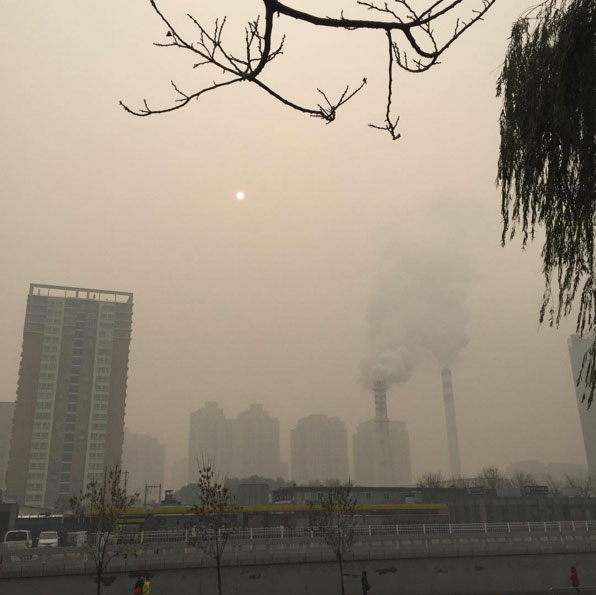
Beijing residents, particularly its young and elderly, have been told to stay indoors to avoid dangerous levels of smog.
The warnings, from China’s Ministry of Environmental Protection, come ironically a week before UN member states are due to meet in Paris to discuss environmental issues as part of COP21, a global conference aimed at encourage countries to reduce carbon emissions and limit the effects of climate change.
China has been notoriously bad at committing to any targets, yet China is the most polluting country in the world. A 2014 environmental study conducted by the Shanghai Academy of Social Sciences determining Beijing is “almost uninhabitable for human beings”, while it’s not unusual when venturing through the city to glimpse large dome-like structures enveloping some of its fanciest private schools – a means to protect China’s young elite from the harmful side effects of nearly unavoidable pollution.
On November 30, 2015 the country’s air-quality index, which deems any reading of more than 300 as ‘hazardous,’ hit a 568, a number that is off the scale of the country’s ranking system. The news will more than likely be a key point of discussion in Paris this week, with more than 190 nations coming together to discuss new action to tackle climate change.
Beijing residents have been chronicling the onslaught of smog through social media, capturing familiar metropolitan sights buried under a blanket of hazy smoke. No filter required.

via @mirrrmiracle

via @cssnakew

via @bzland

via @marmarmarker

via @pianobai
via @echoes_cn

via @sayuri3110

via @chester_117
Enjoyed this article? Like Huck on Facebook or follow us on Twitter.
You might like

As salmon farming booms, Icelanders size up an existential threat
Seyðisfjörður — The industry has seen huge growth in recent years, with millions of fish being farmed in the Atlantic Ocean. But who benefits from its commercial success, and what does it mean for the ocean? Phil Young ventures to the remote country to find out.
Written by: Phil Young

Why is the Amazon’s ‘great roar’ river wave shrinking?
Pororoca — Set in northern Brazil’s edge, a miles long tidal bore has become a destination for waveriders attempting its endless surf. But its future is uncertain, as landscape and weather changes have seen its power mellow in recent years.
Written by: Gaia Neiman

Dropping in at Lahore’s first ever public skatepark
Skate Pakistan — Set right in the centre of Pakistan’s capital city, the free-to-use space has started a mini youth revolution in the country. Z. Raza-Sheikh tracks how it came to open its doors.
Written by: Z. Raza-Sheikh

Inside Louisiana’s ‘Cancer Alley’
Flare pollution — Wayan Barre began photographing life in the 85-mile petrochemical industry corridor after moving to New Orleans. He found defiant activists, health problems and impoverishment.
Written by: Isaac Muk

Dredging and drifting with the last wild oyster fishermen of the River Fal
Cornish pearls — Using only the power of the wind and centuries-old traditional techniques, harvesting oysters in the last wild fishery in England is a sustainable, yet dying, practice. Jack Burke goes trawling with Jason, one of the few keeping it alive, to find out more.
Written by: Jack Burke

Inside the London rollerskating scene’s fight for space
Chop & shuffle — A new, young generation is skating with a style unique to the UK’s capital, but they’re up against security guards, dog units, and padlocks. Sunny Sunday reports on the community’s search for a home.
Written by: Sunny Sunday


