How Douglas Coupland’s life was transformed by a postcard

Author and artist Douglas Coupland never set out to be a writer. He may have penned fourteen books, including the epoch-defining Generation X: Tales for an Accelerated Culture, but it was only when a random postcard he had sent to a friend caught an editor’s eye that he considered the vocation. Communication is an art indeed.
So it all began with a postcard?
Everyone I know who writes fiction was doing something else until about thirty. Until then, maybe they were just incubating. I was in Japan in my twenties and there was no internet then. I was a really good postcard writer. I like stamps and I like the materiality of postcards. They’re real things. So I sent a lot of postcards. Who did I send it to? It was to the wife of my friend Don… I sent her the card and she put it on the fridge. They had a party – I don’t think people entertain at their home very much anymore – that used to happen more. And Mac Parry, who was editor of Vancouver Magazine, said, ‘Oh this guy should write for us.’ She said, ‘Oh! Doug’s not a writer!’ [He said] ‘Well I like his postcard.’ That’s how it started. Within eighteen months, I was writing Generation X in the desert. That was very quick once it happened.
Do you remember what the postcard was? No! She threw it out so I have no idea. No idea whatsoever.
But you wrote many of them. Do you miss postcards? Kind of. They made the mail more interesting. The mail now is just bills and cheques. If someone mailed you something personal, you’d text people and ask, ‘Are you okay? Should we be worried?’

What replaced the postcard? Facebook maybe. But Facebook seems to be mostly humble bragging. ‘Oh, look at me in this great place.’
You were saying you were a damned good postcard writer. Is it important to take pride in seemingly small things? All people like doing things well. If you give people a chance to do things well, they will. It’s only when people don’t believe in what they’re doing that they phone in sick, or they get testy or act out with drugs or drinking or relationship weirdness.
When do creative opportunities arise? You never know. Which is why you have to be out there and doing things and meeting new people and having new ideas. It’s work – life is work – so you might as well work at creating ideas and opportunities.
Do most artists need creative incubation periods? I think all human beings need incubation periods, just as fields need to go fallow. My least favourite state of mind is when I’m nearing the end of a fallow period and am waiting for the ideas to start spewing forth. I’m in that state right now and it’s driving me crazy. But you can’t fight it. So I read and try to not unravel.
Douglas Coupland wrote the foreword to Huck’s first book, Paddle Against the Flow, out now from Chronicle Books.
This article originally appeared in Huck’s Fiftieth Special, a collection of fifty personal stories from fifty inspiring lives. Grab a copy now to read all fifty stories in full and subscribe to make sure you don’t miss another issue.
You might like

What went down at Huck’s 20th birthday party
84 issues and counting — We took over east London’s Jaguar Shoes with friends old and new to celebrate two decades and our new issue, with Tony Bontana taking the decks for a special set.

Inside the Los Angeles scene kid revival
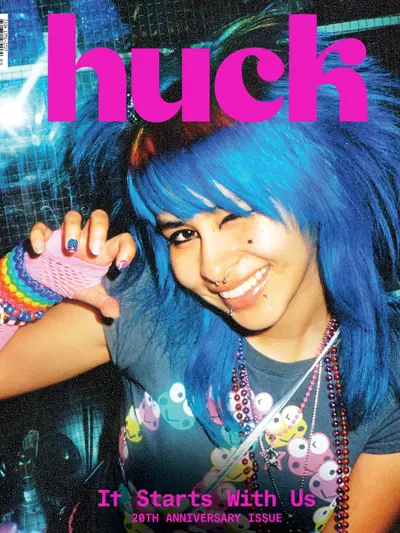
The Rawring ’20s — For the cover of Huck 84, photographer Alexis Gross and writer Anna Zanes meet the latest faces of scene, who are finding freedom to express themselves through its technicolour, unafraid aesthetic.

Introducing our new issue of Huck Magazine: It Starts With Us
Huck 84 — For our second 20th anniversary issue, we spotlight 20 people and groups providing the world with a hopeful future.

Introducing ‘The Chaos Isles’, a new photozine by Huck and Yushy
Normal Island — From unlicensed raves to the solstice at Stonehenge, furries to giant vegetable growers, Yushy is one of the UK’s best lensmen of its wild side. ‘The Chaos Isles’ will be sent out exclusively to Club Huck+ members.

“Magazines are cultural artefacts”: magCulture’s Jeremy Leslie on the enduring importance of print
We love magazines — Despite the ever creeping digitalisation of the world and culture, physical objects are taking on different, yet vital, roles in culture today. Ella Glossop chats to one of London’s biggest proponents of the art about why we need to support independent publications.

“I didn’t care if I got sacked”: Sleazenation’s Scott King in conversation with Radge’s Meg McWilliams
Radgenation — For our 20th Anniversary Issue, Huck’s editor Josh Jones sits down with the legendary art director and the founder of a new magazine from England’s northeast to talk about taking risks, crafting singular covers and disrupting the middle class dominance of the creative industries.


